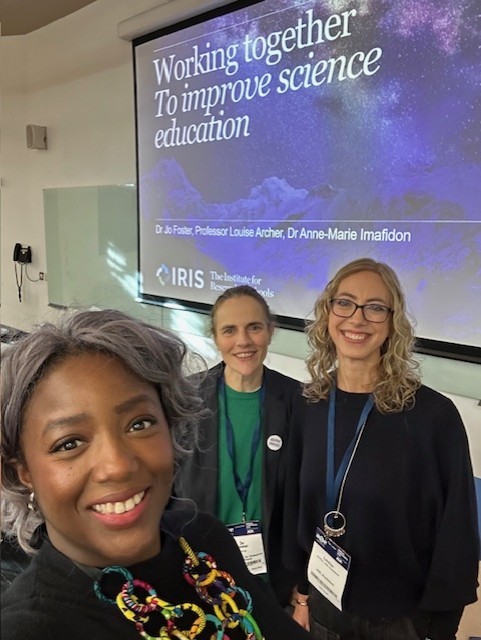
Panel: Working together to improve science education
Professor Louise Archer, ASE President / Karl Mannheim Chair of Sociology of Education, UCL Institute of Education, Jo Foster, Director, IRIS (Institute for Research in Schools) & Anne-Marie Imafidon, Chief Executive, Stemettes
Despite decades of investment, innovation and good intent, outcomes in science education in England remain deeply uneven. Participation gaps persist, confidence declines as students progress through school, and recent international data suggests a worrying fall in attainment. This panel session asked a deliberately uncomfortable question: if we know so much, why hasn’t more changed?
Bringing together perspectives from research, practice and advocacy, the session explored why fragmented efforts, however well-meaning, have failed to deliver systemic change, and what a more coherent, collective approach might look like.
Professor Louise Archer, drawing on two decades of ASPIRES research, highlighted the persistence of inequalities in science participation by gender, ethnicity and social background. Her contribution challenged the assumption that aspiration-raising alone is enough, arguing instead that structural barriers within curriculum, assessment and school cultures continue to shape who feels that science is “for them”.
Dr Anne-Marie Imafidon reflected on representation, culture and belonging, emphasising how young people’s experiences of science are shaped not just by what is taught, but by how science and scientists are portrayed, and who is seen as legitimate within the system. She stressed the importance of moving beyond isolated interventions towards sustained, joined-up action.
The discussion was framed by the idea of collective sense-making: recognising that no single organisation, policy lever or programme can solve these challenges alone. Instead, progress depends on alignment; between research evidence, classroom practice, policy decisions and the wider ecosystem of organisations working in and around schools.
Audience contributions reinforced this message, with teachers and leaders reflecting on workload pressures, accountability constraints and the gap between policy ambition and classroom reality. There was strong consensus that collaboration must be purposeful and disciplined, not performative, focused on reducing duplication, building shared understanding, and keeping young people’s learning experiences at the centre.
The session closed with a note of cautious optimism. While the challenges are real and entrenched, the energy in the room demonstrated a shared commitment across the community to rethink how we work together, and how we ensure that science education genuinely serves all young people, not just a fortunate few.