Power up your Oscilloscope Skills
Alex Wu MEng MIET, New Product Developer, Philip Harris - part of the Findel Education Family
This workshop provided a practical introduction to the fundamentals of using an oscilloscope and understanding basic waveform analysis through a hands-on, guided practical approach. The session focused on building confidence with using a piece of equipment commonly used in electronics, physics, and engineering environments. Since oscilloscopes are often available in schools but usually older models and with limited training material, they can and often are seen as intimidating pieces of equipment. This session was designed for beginners with little or no prior experience with the aim being to de-mystify and increase accessibility of using one.
The workshop began with an overview of what an oscilloscope does and how to read the information on the screen, visualising it as a graphical voltmeter. Then moved onto oscilloscope components and controls, including probes, channels, time base, voltage scaling, and triggering functions. Participants learned how oscilloscopes visualize electrical signals over time and how to safely connect and configure the instrument for accurate measurements.
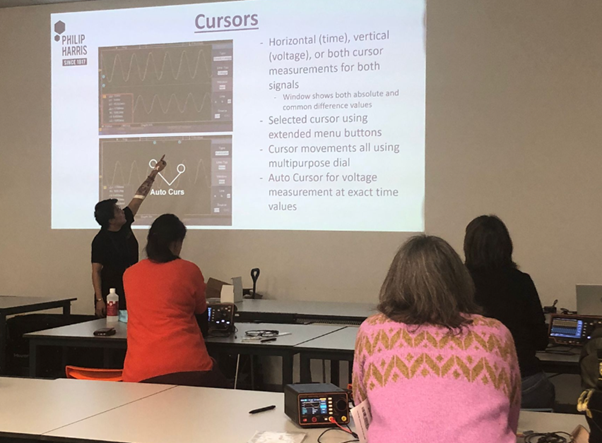
The UNILAB power signal generator was used to provide different signal sources. Participants practiced measuring basic waveform features on sine, square, and triangular waves, and adjusting vertical and horizontal time and voltage scales to properly display signals. Key waveform characteristics such as amplitude, wavelength, frequency, and offsets were explained and measured using the oscilloscope cursors.
The workshop touched on possible unexpected issues like signal noise, distortion, and the effects of probe attenuation and bandwidth limitations. Practical troubleshooting tips were incorporated to help users diagnose common signal display issues, and a quick tutorial on the process of probe compensation was covered.
By the end of the session, participants had gained hands-on experience operating an oscilloscope, interpreting waveform data, and applying basic analysis techniques. Example experiment ideas were covered, and the setup for running the Speed of Sound experiment using an oscilloscope and two microphones was covered, this going into detail about trigger functions and controls.
The oscilloscope units provided for the participants were the new UNILAB EasyScope digital oscilloscopes. Though the session was tailored to the controls on this particular model, all features and concepts are transferable to any digital oscilloscope.