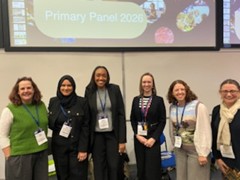
Strategic Developments in Primary Science: Insights from the 2026 ASE Primary Panel
Claire Seeley MA CSciTeach, Sarah Earle, Hannah Osueke, Maria Mehrin, Nicki Deane & Katie Adams
The 2026 Association for Science Education (ASE) Primary Panel, held at the University of Nottingham, provided a robust examination of contemporary strategies designed to overcome systemic barriers in primary science. Facilitated by a panel of expert primary practitioners—including Claire Seeley, Sarah Earle, Maria Mehrin, Hannah Osueke, Katie Adams, and Nicki Dean—the discussion focused on elevating the subject from a collection of activities to a rigorous academic discipline.
A central theme of the panel was the transition from passive "hands-on" activities to cognitively demanding "minds-on" engagement. By shifting the focus toward the "how" and "why" of scientific processes, the panel argued that educators can ensure practical work serves as a vehicle for deep conceptual change, rather than remaining a superficial classroom experience.
Curriculum Coherence and Career Integration
In an increasingly crowded primary curriculum, the panel explored the vital importance of establishing a clear purpose for scientific learning. Panelists shared insights into curriculum design, highlighting the need to make explicit links between classroom theory and science in the real world. By integrating career-related contexts early on, educators can provide students with a roadmap of how their learning applies beyond school gates, fostering curiosity and aspirations.
Closing the Language Gap through Disciplinary Oracy
The panel reached a strong consensus that addressing the "language gap" remains a significant priority. To support learners in developing robust scientific vocabulary, the experts shared four key strategies:
- Vertical Mapping: Explicitly mapping technical terms across year groups to ensure clear, non-repetitive progression.
- Contextual Learning: Reducing cognitive overload by limiting vocabulary to approximately ten key words per unit, introduced strictly within relevant contexts.
- Reading for Productivity: Utilising a three-tiered reading approach. Once "Tier 3" (subject-specific) vocabulary is taught, learning is consolidated through information extracts where key words are encountered in professional or academic contexts.
- Multimodal Support: Incorporating "Talk for Writing" actions and Makaton signing to help students internalise abstract technical terms through physical movement.
Engagement Beyond the Classroom
The session concluded with strategies for extending science engagement into the home. Success stories included the use of "science bags"—portable kits containing equipment for home experimentation—and interactive knowledge organisers that bridge the gap between school and family life. By fostering a culture where students are encouraged to "think like a scientist" in all contexts.