Use of AI in curriculum implementation
Andy Chandler-Grevatt, Curriculum Editor for Smart Activate Oxford University Press
In this session, we had a good crowd of teachers, consultants and other science educators who were all interested in how we can use generative AI in the curriculum. I introduced how I went about developing the Oxford Smart Curriculum before generative AI was readily available. I approach the use of AI curiously and cautiously so, as an experiment, I tried to use generative AI to do the same job with the same information and see what came out.
Presenting some plausible outputs, we discussed them and started to realise some flaws and limitations. Including how to prompt the model to use the overarching principles of curriculum design, the nuance of decisions for progression pathways and the transition from high level headings into workable activities and lesson plans.
Although generative AI seems to be useful for small tasks such as writing multiple choice questions, making worksheets and short-term plans, we lack confidence in open AI being able to reliably. We recognised that any output required some professional safeguards, namely:
- Use AI for first drafts, not finished products
- Always fact check with trusted sources
- Use prompts that guide the AI toward curriculum intent
- Have department norms for reviewing AI generated materials
- Keep examples of good and bad outputs to train colleagues
At the end, Andy recognised the closed AI systems are far more powerful for planning and assessment within a curriculum. This is the likely future of curriculum development with AI tools. And so, we proceed curiously, but cautiously.
Moss Safari: A gateway to microscopy
Andy Chandler-Grevatt, University of Brighton, Founder of Moss Safari
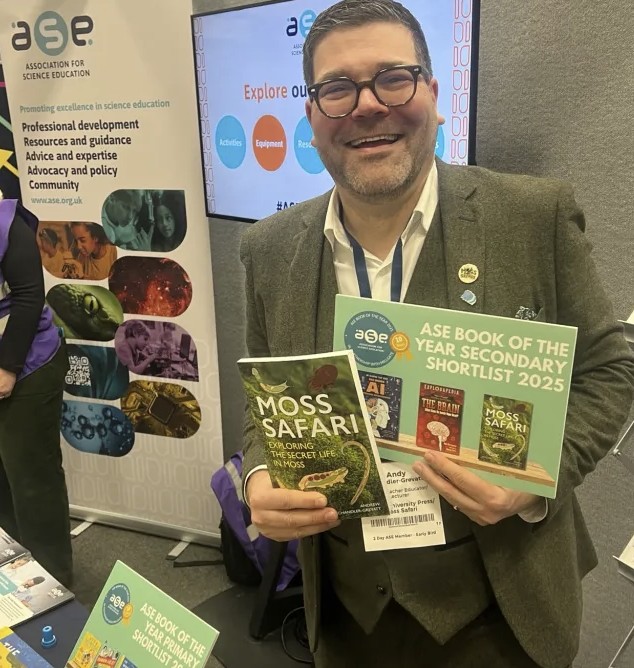
If you have attended ASE Conferences over the past five years or so, you will have seen that Moss Safari has grown, and this year I was delighted that my book Moss Safari: The Secret Life in Moss (Pelagic Publishing) was shortlisted for the secondary ASE book of the year award. The session I presented explored how Moss Safari can be used by teachers at primary, secondary and tertiary levels to inspire learners about the natural world.
If you haven’t encountered Moss Safari before, it is a very simple activity: squeeze some wet moss onto a microscope slide and observe it. Within the water droplets, a host of organisms can be found. In fact, representatives of all five kingdoms live in moss, including bacteria, protists, fungi, animals and plants, all on the microscopic scale.
To help navigate this rich diversity of life, Moss Safari uses the idea of the ‘Microscopic Big Five’, the multicellular organisms most commonly found in moss. These include lumbering mites, frantic nematodes, industrious rotifers, resilient tardigrades and the enigmatic gastrotrichs. Using the Moss Safari identification sheets, participants search for these organisms on their slides, learning to observe, identify and compare what they see.
During the session, I explained how Moss Safari now has three core aims: to connect people with nature, promote microscopy, and inspire STEM hobbies and careers. These aims are supported through free online resources that can be used in curriculum-linked lessons, extracurricular activities, and public engagement events such as New Scientist Live.
Each of the Microscopic Big Five has its own remarkable life story. Many of these animals have adaptations that allow them to survive when moss dries out or freezes; in the case of nematodes, rotifers and tardigrades, this involves placing their life cycle on pause. Moss itself functions as a complete ecosystem, and together these organisms illustrate key concepts such as ecology, natural history, climate change and biodiversity. Sharing these microscopic stories is a particular joy.
The main focus of the presentation was to showcase the free, downloadable resources available to teachers and hobbyists at all levels. Anyone can run their own Moss Safari using the one-page instruction infographics, which are pitched at three levels: beginner (primary), intermediate (secondary) and advanced (A-level/T-level). Alongside the identification sheets, there are also infographics exploring the life histories of each of the Microscopic Big Five.
It was a pleasure to talk with delegates about their own Moss Safaris, the book, and the extraordinary life found in moss, and the conversations that followed highlighted just how powerful moss can be as a starting point for curiosity, careful observation and sustained engagement with science.