
ASE Evaluated for LEGO® Education Science
Introduction
LEGO® Education has expanded its offering to deliver curriculum-aligned, enquiry-based science resources for learners aged 5–14. The kits are designed to foster creativity, critical thinking, and problem-solving through hands-on learning, integrating technology, and engineering principles with core science concepts. This review brings together separate and independently evaluated assessments of the 5+ (Years 1-3), 8+ (Years 4–6), and the 11+ (Years 7–9) kits. Each kit has been assessed for curriculum alignment, pedagogical value, and practical classroom application.
LEGO® Education Science will be running a session at our Annual Conference on Thursday 8th January: Transforming science learning through collaboration and creativity
Product overview – Primary and Secondary
| Age Range | Kit Focus |
|
5+ |
Early science, habitats, materials |
| 8+ (Y4–6 English National Curriculum) |
Forces, electricity, evolution |
| 11+ (Y7–9 English National Curriculum) |
Biology, chemistry, physics |
The contents of each box vary to suit the learners’ age and the science content. The kit comes in a durable, stackable storage box: perfect for classrooms that will need more than one kit to use it as intended. It also comes with three large LEGO® instruction build booklets that cover all tasks. The size and layout make it easy for students to view the instructions at once, although placing the booklet on a bookrest makes this even easier compared to leaving the booklet flat.
The kits are designed for groups of four students, each of whom has a particular role during the build. There are four minifigures, each of a different colour, and these correspond to specific build instructions within each task. This is a simple way to ensure that no single student takes over all the building, whilst also requiring minimal input from the teacher to organise. The pieces are sorted by colour, and the tray is large enough to make it easy for students to locate their bricks swiftly.
Kits also come with access to a free online teacher portal containing lesson plans, presentations, and facilitation notes. The set-up is simple and a QR code directs you to a welcome video, from where you can register for a LEGO® Education account and access the lesson resources. Anyone can register for an account to see the resources and content prior to purchase.
The online lesson interface for teachers is easy to find and simple to use. It includes filters for age and subject, as well as a feature that lets teachers flag favourite lessons, which are automatically pinned to the top of the list. This makes finding what you need quick and efficient. The lessons each come with a presentation and teacher plan designed for a 30-45-minute lesson. Each are adaptable for different needs and school timetables.
The lesson presentations are not editable and are available online only. They play well in full-screen mode and are visually appealing, with the ability to adjust the timer for the build time as well as to start and stop it. Considering the age and potential ability range of students, this is a very helpful feature, allowing teachers to tailor the pace to their class and maintain students' focus. The presentations follow a pedagogically appropriate structure and are designed to support a full lesson if required, rather than serve as stand-alone tasks to be inserted into an existing lesson.
In addition to the main resources, there are links further down the lesson page for the curriculum reference, 21st century skills used and prerequisite knowledge. There are also boxes to click on for ‘Go Deeper’ ideas and other subject links. This information is particularly useful for middle leaders who need to cross link content and skills, so it is great that LEGO® has included more than just pure content links.
Pedagogical structure
All kits follow structured instructional models based on the 5E model – Engage, Explore, Explain, Elaborate, Evaluate.
Each lesson includes:
- Starter questions and recap of key terminology
- Guided build phase with interactive timer
- Concept explanation linked to models
- Opportunities for the children to reflect and explain their model, before extending their learning through open ended model design and problem solving.
- Detailed teacher guidance (facilitation notes) which follow the 5E methodology and could be useful for those who are teaching outside their specialism
The online portals allow filtering by age and subject, bookmarking favourite lessons, and accessing build instructions and hardware guides. There are curriculum references and knowledge requirements, cross-curricular links and online build instructions (to supplement the paper ones in the box).

All images reproduced with permission of LEGO® Education
Curriculum coverage
Primary kits (Years 1-3 and Years 4-6)
- Science Topics: Seasonal change, light, materials, plants, habitats, forces, states of matter, sound, electricity, evolution
- Cross-Curricular Links: Geography, Design Technology, Engineering
- Strengths: Engaging contexts (e.g. “Ra Ra Rattlesnake”), consistent presentation format, accessible facilitation notes
- Limitations: Some activities (e.g. “From Egg to What?”) offer limited added value over traditional methods
Secondary kit (Years 7–9)
- Science Topics: Biology (20 lessons), Physics (7), Chemistry (2), plus Geography and Design and Technology
- Strengths: Strong enquiry focus, sensor integration, adaptable for KS4/KS5, excellent for visualising abstract concepts
- Limitations: Chemistry underrepresented; some terminology inconsistencies (e.g. energy flow vs energy transfer)
ASE reviewed activities
| Activity | Subject | Highlights |
| Forest Showdown (C101) | Biology | Ecosystem balance, food chains |
| Supercharged Plants (C112) | Biology | Light sensors, energy transfer, photosynthesis misconceptions |
| More than a Nucleus (C114) | Biology | Cell modelling, 3D organelle representation |
| Kinetic Kicker (C202) | Physics | Kinetic energy, friction, enquiry skills |
| Push Power (C203) | Physics | Newton’s laws, safe and repeatable demonstration |
| Frosty Fur (C304) | Biology | Natural selection, adaptation over generations |
| Troll Stole My Soup (C309) | Chemistry | States of matter, reversibility, particle modelling limitations |
| Energy Chain | Biology (Y4 -6) | Conceptual reinforcement of energy transfer |
Strengths across both kits
- High engagement and accessibility for diverse learners including learners with special educational needs and disabilities (SEND)
- Whilst not specifically designed for homeschooling it is a possibility with the kits
- All kits are engaging, accessible, multi-sensory and age appropriate
- Strong visual and tactile reinforcement of scientific concepts
- Embedded enquiry and problem-solving skills
- Clear links to curriculum and cross-curricular opportunities
- Well-structured teacher support materials – clearly presented
A closer look at the evaluation findings of the primary LEGO® Education science kits
We evaluated a select number of lessons across the primary kits. For example, the “Ra Ra Rattlesnake” session explores defence mechanisms through model creation and extension activities that promote creative application of the scientific concept.
The layout is consistent, with slides which are clear and simple including outcomes and a logical sequence following the 5E model, making it familiar and easy to use.
Each slide in the presentation includes:
- Tabs which open a video of the hardware needed and how to use it
- A model tab showing the LEGO® model
- A timer tab for timing the actual building of the model; which can be altered according to class adaptations.
The facilitation notes support the teacher with the required background knowledge on the science concepts and guiding them through the 5E process. The notes are easy to follow and include introductory questions for each slide as well as supportive answers and suggestions for structuring the group's learning. The notes also support the teacher through the 5E process which is a key principle in the use and structure of the resources.
Years 1-3 Science activities include:
- Seasonal Change – Sunshine Parade
- Light – Park Picnic, Dim Dance Party, Light Monster and What the Sun Sees
- Materials – Kitty Greetings, Troll Under the Bridge and Sort It Out
- Plants and Animals – Farm Friends Road Trip, Flower Families, Perfect Hiding Spot, Worms for Dinner, Dragon Care, Monster Nursery and Hide the Seeds
- Forces and Magnets – Dino Birthday Bash, Muddy Rhino and Feeding Time
- Living Things and Habitats – A Home for Baby Bird, Animal Hotel, Flower Friends, Forest Play Day, Best of Nests and Animal Rescue Team
Years 4-6 Science activities include:
- States of Matter – Stink Squad
- Sound – Feel the Beat
- Electricity – Nature Party
- Materials – Snacking Seagull and Wheel of Properties
- Plants and Animals – Protect Baby Elephant, Plant Powers, Ra-Ra-Rattlesnake, Navigating the Unknown, Sun Snack, Circle of Soil and Energy Chain
- Forces – Sweet Tooth Squirrel, Golfing Over the Edge, Energy Racer, Crush the Core, Down With Gravity and Slow Down Race
- Evolution and Inheritance – Fossil Detective, Spot the Bug, Fire and Horns and Deep Down Underground
- Living Things and Habitats – From Egg to What?, Home at Last, Hungry, Hungry Lionfish and Critter Crossing
Summary of the primary LEGO® Education science kits
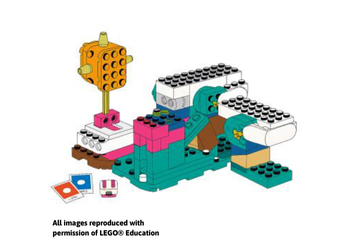 All the resources follow a consistent theme across the online materials, support, and the traditional instructional build book. The value of the resource sets is dependent on the context in which they're used. They are ideal for pupils who require additional support or who find it difficult to record their understanding on paper or verbally. The sets are also effective for whole class use as all learners can participate and access the science activities, including learners with SEND who may struggle with traditional teaching methods.
Having reviewed all the science activities, it was evident that several effectively support the reinforcement of conceptual models previously taught, such as using the LEGO® Education Science “Energy Chain”, in the Years 4-6 Plants and Animals session.
A closer look at the evaluation findings of the secondary LEGO® Education kit
We also evaluated a select number of lessons across the secondary LEGO® Education Science kits.
- All lessons start with a “Big Enquiry” question to activate students’ background knowledge (such as ‘what would happen if all the foxes disappeared?').
- A recap of key ideas and terminology (with handy callouts for some potentially unfamiliar terms). Vocabulary is embedded in the activities to support acquisition by all learners including those with dyslexia or English as an additional language.
- A build section (the ‘Explore’ phase), directing students to the build booklet and number, with assigned roles (using four minifigures as a visual reminder) and an interactive timer using the four single colour minifigures to divide into roles.
- Time to explain the concept and link it to the models (the ‘Explain’ phase).
- An opportunity in group discussions and feedback to develop, change or analyse the build and link it back to the planned outcomes and connections to the real world or alternatively, to build something new.
This maintains both interest and pace, with good visuals accompanying it. The build time is generous for those with experience of LEGO® but allows time for students who may have lower affinity with LEGO® bricks and/or still be developing their fine motor skills. The build time is easy to change in the presentation; this is a tweak many teachers would need to make. There is scope to expand some of the development phases too, with some tasks lending themselves to full investigations with measurements and graphs as natural expansions of the topics.
Overall, these are well-structured lessons with plenty of opportunity to tag on some initial retrieval from, or links to, other aspects of the curriculum.
Overall, the range of lessons the kit can be used for is impressive, with some builds, particularly in the physics suite, lending themselves well to further investigations aligned with the KS4 curriculum. The design of the kits to allow independence across a broad range of abilities is excellent, and the supporting materials make planning and linking the tasks to the correct schemes of work very simple. Students thrive when they can visualise concepts and experiment with them safely for themselves, and this kit provides ample opportunity for that. There has clearly been a lot of research into cornerstone concepts and common misconceptions, which has fed into the design of the builds and the teachers’ notes for follow-up questioning. The terminology is generally ability-appropriate, and LEGO® is endlessly engaging; the inclusion of sensors and unusual contexts is bound to increase the sense of wonder and demonstrate the importance of creative thinking and experimental design in science.
Summary of the secondary LEGO® Education kit
LEGO® Education Science kits offer a compelling blend of hands-on engagement and curriculum alignment across primary and secondary phases. While some activities could be replicated with simpler resources, the kits excel in promoting enquiry, collaboration, and conceptual understanding especially in physics and biology. With targeted refinements in chemistry content and terminology, these resources could become cornerstone tools for inclusive, investigative science teaching.
Resources Reviewed: November 2025
About ASE Evaluated
ASE Evaluated’ is a recognised mark of quality assurance that indicates science education resources have been reviewed and evaluated by ASE. ASE can evaluate any type of resource including teaching guidance, lesson plans, practical activities, books and equipment.
Resources are evaluated to ensure they meet minimum standards for:
- Engagement and accessibility
- Evidence-informed and scientifically accurate content
- Alignment with national curricula
- Connection to clear and relevant pedagogy
- Innovation or added value
- Compliance with health and safety regulations
